Backpack Survivors : Idle RPG
- 3.9
- Rating
- 1.00M
- Installs
- Free
- Price

 Analysis by App-foxy
I approached Backpack Survivors: Idle RPG expecting a light role-playing game built around quick decisions rather than long sessions, and that is the right way to understand it. The central idea is simple: manage the weapons in your backpack, send your survivor into danger, and watch the setup deal with waves of monsters. It is designed for people who enjoy improving a build in small steps without needing to control every second of a battle.
That simplicity is also the game’s main test. You are not getting a traditional role-playing adventure with a large world to explore, a long dialogue campaign, or detailed manual combat. The appeal comes from arranging your equipment intelligently and seeing whether the next encounter exposes a weakness in your plan. I found that the most satisfying moments came from making a small change to the backpack and immediately understanding why the result improved.
What to expect when you begin
This is a free role-playing game from Purplecow games, with an Everyone age rating and support for Android 7.0 or later. It has already passed the million-install mark, while its average sits at 3.9 from around 1.8 thousand ratings. Those figures suggest a game with a broad casual audience, but they also set a realistic expectation: it is approachable and easy to sample, not necessarily a deep replacement for a full-scale RPG.
You May Also Like

 Blood Strike: 2.5 Anniversary
Blood Strike’s Loadouts Turn Every Drop Into a Tactical Gamble
A close look at Blood Strike’s custom loadouts: how fast access to signature weapons reshapes its battle royale rhythm, rewards preparation, and narrows the gap between fights.

 Pandora - Music & Podcasts
Pandora’s Music Is Easy to Start, but Harder to Recover
Pandora’s strength is its low-effort path from a seed to a station. Its weak spot is how much confidence it asks you to place in connection, setup, and quiet recovery.

 8 Ball Pool
 Is Built on Rivalries, Rematches, and Routine
A close look at the rivalries, rematches, shared routines, and unanswered safety questions that turn a quick pool match into a persistent mobile community.

 Samsung Music
’s Quiet Strength Is Playing What You Already Own
Its reach comes less from spectacle than from dependable access to a personal library. That simplicity is both the app’s strongest retention engine and its ceiling.

 AccuWeather: Weather Radar
AccuWeather Review: A Quick, Clear Forecast for Everyday Decisions
For everyday plans, the best forecast is the one you can understand quickly. AccuWeather makes rain timing, radar, and local conditions easy to act on, with a few trade-offs.

 Hill Climb Racing
Why Hill Climb Racing Still Turns Crashes Into One More Run
A tiny car, a bumpy hill and one more upgrade: Hill Climb Racing keeps resurfacing because its simple chaos makes every near-miss feel personal.
More From Our News Desk



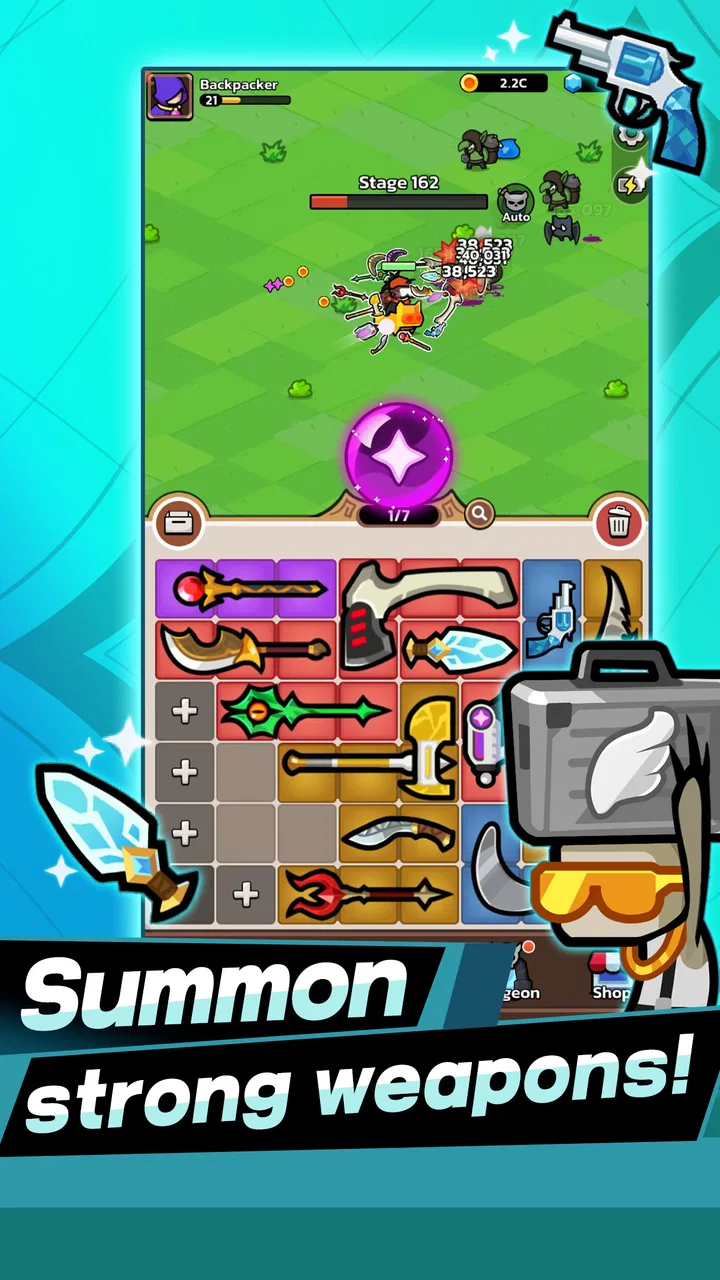
The store presentation describes it as an idle survivor RPG, but I would not treat “idle” as meaning there is nothing to think about. The active part is the preparation. Your backpack is effectively the character sheet, equipment screen, and tactical puzzle in one place. Weapons compete for room and attention, so simply collecting more items is not automatically the same as becoming stronger.
In a typical session, I would check the available equipment, decide which pieces deserved space, and then let the survivor face another group of monsters. That rhythm works especially well when I only have a few minutes. It also makes the game suitable for a commute, a short break, or the moment when I want progress without committing to a complicated quest.
The game is free to download, which makes trying it straightforward. Still, free access does not guarantee that every player will enjoy the same pace. If you prefer precise movement, active dodging, or direct attacks, this may feel too hands-off. If you like optimizing a compact loadout and watching preparation pay off, its focused design is much more appealing.
The backpack is the real starting point
New players may initially look at the monster waves and assume that survival is mostly about waiting for stronger weapons. I think that is the wrong first lesson. The backpack should be treated as a limited decision space. Before each meaningful attempt, ask what your current arrangement is trying to do: clear groups quickly, handle tougher targets, or simply survive long enough for your damage to accumulate.
That question prevents a common mistake: keeping every new weapon just because it looks useful. A crowded setup can be less effective than a smaller, clearer one. When I reviewed a loadout, I paid attention to whether each item had a job. If two pieces seemed to serve the same purpose, I considered whether one could be removed or replaced rather than assuming that both automatically improved the build.
The first useful habit is to change one part of the backpack at a time. If you replace several weapons together, it becomes difficult to understand what actually helped. A single adjustment gives you a cleaner comparison in the next battle. That approach is slower than making random changes, but it turns the game from a guessing exercise into a manageable experiment.
Setting up without overthinking it
On the first launch, I recommend resisting the urge to chase an ideal arrangement immediately. Start by learning how the game presents equipment and where it shows the result of a battle. The important early goal is not to create a perfect survivor; it is to understand the relationship between backpack choices and monster clearing.
Use the first available weapons as a learning kit. Place them in a way that feels organized, then begin an encounter and watch what happens. Notice whether the survivor struggles against groups, takes too long to finish a target, or loses momentum before the wave ends. Those observations are more valuable than trying to copy a strategy you do not yet understand.
I also suggest keeping the early backpack visually simple. When every slot is filled with unfamiliar equipment, it becomes harder to see which item is responsible for a change in performance. A tidy arrangement lets you identify the pieces you rely on and the ones that are merely taking room. This is one of the game’s quieter skills, and it matters more as the number of choices grows.
Another practical tip is to treat a failed attempt as information rather than a reason to rebuild everything. If the survivor nearly succeeds, make a modest adjustment and try again. If the result is much worse, return to the previous arrangement and change a different element. This process gives the idle structure a hands-on layer without turning it into a frantic action game.
How to reach the first meaningful success
Your first meaningful success is not simply watching a battle finish. It is recognizing why your survivor handled the encounter better than before. For me, that happened when I stopped adding weapons automatically and started giving the backpack a clear purpose. The improvement felt earned because it came from organization, not from blindly waiting.
Begin with a basic cycle. Review what is available, choose the equipment that appears most useful, arrange it carefully, and start the next fight. During the encounter, look for the point where progress slows. That slowdown tells you what to address. If groups remain on screen too long, prioritize the part of the setup that helps with repeated clearing. If a stronger opponent causes the run to collapse, think about whether your current arrangement lacks enough sustained power or balance.
After the battle, avoid judging the result only by whether you won. A victory that leaves the setup poorly understood may not help much later. Conversely, a narrow defeat can reveal exactly what needs attention. I found the game more enjoyable when I used each result to answer one question: what is the weakest part of this backpack right now?
Once you identify that weakness, make one focused change. This is a particularly useful workflow for first-time players because it keeps the learning curve calm. You do not need a guide open beside you, and you do not need to memorize a complicated build. The game becomes readable when you connect a visible problem with a deliberate equipment decision.
My strongest early recommendation is to value a dependable arrangement over an exciting but confusing collection. A weapon that fits your plan is often more useful than a new item that forces you to reorganize everything without a clear benefit. That trade-off is easy to miss because collecting feels like progress, while editing feels like giving something up.
Where new players commonly get confused
The word “idle” can create the expectation that the best choice is to leave the game alone and return later to collect results. That approach may be convenient, but it overlooks the game’s main interaction. The backpack is not decoration. It is where your decisions matter, and ignoring it can leave you with a collection of weapons that looks impressive but does not work together well.
Another source of confusion is assuming that the largest number of items must produce the strongest survivor. Space and organization matter. When the backpack becomes cluttered, you may lose sight of which equipment is helping and which is simply present. I recommend periodically asking whether the current arrangement still has a clear purpose instead of treating every new addition as permanent.
Players can also misread a slow battle as a problem that requires a completely new build. Sometimes the issue is narrower. A single weak point may be holding back an otherwise sensible setup. Changing everything at once removes the chance to learn from the encounter, so I would first test a small revision and compare the result.
There is also a difference between progress that feels visible and progress that is useful. A new weapon can make the inventory look more advanced, but the real question is whether the survivor performs better in the situations that were causing trouble. I found it helpful to judge equipment by results over several encounters rather than by appearance or novelty alone.
If you are expecting a story-heavy RPG, the game may surprise you in another way. Its identity is built around survivor-style battles and backpack management, not around role-playing through conversations and exploration. That is not a flaw, but it is an important boundary. Someone looking for character relationships, a large map, or detailed narrative choices would probably be happier with a conventional adventure RPG.
Small decisions that make the game easier to read
One useful method is to keep a mental “before and after” record. You do not need to write down every result. Simply remember the problem you saw, the one item you changed, and whether the next encounter improved. This makes the game feel less random and helps you build confidence without relying on external advice.
A second method is to avoid rebuilding immediately after a good result. When a setup performs well, leave it intact for a little while and learn its limits. The next failure will tell you more than constant rearrangement because you will know which foundation was already working. This is especially helpful for players who tend to react to every new item by changing their entire backpack.
A third insight is that short sessions can be more productive than long, unfocused ones. Because the game revolves around repeated encounters and incremental adjustments, opening it with one specific goal works well. You might decide to test a weapon, simplify the backpack, or find the reason a particular wave is slowing you down. That gives an otherwise passive format a sense of direction.
For an everyday example, imagine checking the game during a lunch break. You have enough time to review the backpack, notice that the last encounter stalled, replace one questionable weapon, and start another attempt. You can then return later and see whether the change helped. That is a better use of the game than repeatedly tapping through battles without observing the outcome.
How it compares with other role-playing choices
Compared with a traditional RPG, this game asks for much less time and offers a much narrower form of control. You are not steering through a large environment or manually timing every attack. The reward is convenience: the core decision is concentrated in the backpack, so you can engage with the strategy without learning a large control system.
Compared with a pure idle game, it gives you a more tangible reason to stay involved. The equipment arrangement creates a feedback loop. You make a choice, watch the survivor face monsters, and then decide whether the result justifies the setup. Players who want completely passive progress may find this extra layer unnecessary, while players who find ordinary idle games too empty may appreciate it.
It also differs from action-focused survivor games. Those games often test movement, reaction, and positioning during a live run. Here, the emphasis is on preparation and equipment management. If your favorite part of the genre is weaving through enemies yourself, this will feel less energetic. If you prefer thinking before the fight and observing the result, the slower pace is an advantage.
The comparison matters because the game is easiest to enjoy when you choose it for the right reason. I would recommend it to a casual RPG player who likes collecting options but does not want a demanding control scheme. I would skip it if my priority were a rich story, direct combat, or a highly social role-playing experience.
Who will get the most from it
This is a good fit for first-time players who want a gentle introduction to equipment-based strategy. The backpack gives you a concrete place to learn, and the monster encounters provide immediate feedback. You can experiment without needing to understand every role-playing convention at once.
It also suits players who enjoy optimization in small doses. You can play for a short period, make one decision, and leave with a clear idea of what to test next. That makes it more approachable than a large RPG when you are tired or short on time.
On the other hand, players who need constant manual input may lose interest. The game’s satisfaction comes from preparation, not from controlling every attack. It is also not the best choice for someone who wants a deeply authored adventure. The free price removes much of the risk of trying it, but it cannot change the game’s focused design.
What to do after the first success
Once your initial arrangement starts handling encounters reliably, move from survival to refinement. Look for unnecessary clutter, identify the weapon that contributes least to your current plan, and test whether a cleaner backpack performs more consistently. Do not assume that the setup that wins one encounter is finished; its weaknesses may appear when the pressure changes.
At this stage, it helps to create small personal rules. For example, you might only replace one item after a disappointing result, or you might keep a familiar arrangement while testing a new weapon separately. These rules are not imposed by the game, but they make your progress easier to understand and reduce the temptation to make random changes.
Think of each new improvement as a trade-off. More variety can give you more possibilities, but it can also make the backpack harder to read. A simpler setup may feel less exciting, yet it can be easier to evaluate and repeat. That tension is where much of the game’s practical strategy lives.
The current version is 1.1.08, and the game was released on September 18, 2024. Those details are useful when checking compatibility or deciding whether your device meets the basic Android requirement, but they do not change my central advice: begin slowly, learn the backpack, and make changes with a reason.
My recommendation after spending time with it
Backpack Survivors: Idle RPG works best as a compact, low-pressure role-playing game for players who enjoy making equipment choices and watching those choices unfold. Its strongest feature is the way the backpack turns a familiar survivor setup into a small planning puzzle. I liked that a modest adjustment could make a battle easier to understand and a short session feel worthwhile.
Its limitations are equally clear. The hands-off combat will not satisfy everyone, and the focused backpack loop may feel repetitive if you need a large story or constant action. The game rewards patience and observation more than reflexes, so choosing it over a traditional RPG or an action survivor title depends entirely on what you want from the session.
For a first-time user, I would install it with one simple goal: learn why a weapon belongs in your backpack, rather than trying to collect everything immediately. Give the first encounters your attention, change one thing at a time, and use each result to guide the next attempt. If that kind of gradual improvement sounds satisfying, Purplecow games has made a free and accessible entry in the role-playing category that is easy to try and surprisingly thoughtful once you start treating the backpack as your main strategic tool.
FAQs for Backpack Survivors : Idle RPG
01What is Backpack Survivors: Idle RPG?
Backpack Survivors: Idle RPG is a mobile role-playing game that combines idle progression with backpack and inventory management. You collect heroes, equipment, weapons, and useful items while fighting through increasingly difficult encounters. The main strategy involves arranging items in your backpack so their effects work together, allowing your team to become stronger even when you are not actively playing.
02How does the backpack system work in Backpack Survivors: Idle RPG?
The backpack is more than a storage space; it is an important part of the game’s combat strategy. Items usually occupy different amounts of space and may provide bonuses when placed near compatible equipment or grouped in a particular way. Managing limited slots, choosing upgrades, and creating effective item combinations can significantly affect your performance during battles and progression.
03Can I play Backpack Survivors: Idle RPG offline?
The game is designed around idle rewards, so some progression may continue while you are away from the app. However, certain features can require an internet connection, including advertisements, cloud synchronization, events, purchases, updates, or online reward verification. Availability may also vary between versions, so players should not assume that every mode or reward system works fully offline.
04Is Backpack Survivors: Idle RPG free to download and play?
Backpack Survivors: Idle RPG can generally be downloaded without an upfront payment, but it may include optional in-app purchases and advertisements. These can provide resources, speed up progression, unlock convenience features, or offer special bundles. You can usually make progress without spending money, although free players may experience slower advancement and more frequent limits than paying users.
05Is Backpack Survivors: Idle RPG suitable for casual players?
The game is a good fit for players who enjoy short sessions, automatic battles, collecting upgrades, and gradually improving a character or team. You do not need to remain active constantly because idle systems help generate progress over time. Nevertheless, players who want the best results will still need to check rewards, reorganize equipment, and make strategic decisions regularly.
Pros
- Simple idle progression works well for short play sessions.
- Runs smoothly on most modern Android and iOS devices.
- Frequent rewards encourage regular logins.
- Offline earnings let progress continue while you are away.
- Compact matches make it easy to play during commutes.
Cons
- Progress can slow noticeably without upgrades or extra resources.
- Random ability choices may make some runs feel unfair.
- Repeated stages can become monotonous over time.
- The interface may feel crowded on smaller phone screens.
- Some features may require a stable internet connection.

Backpack Survivors : Idle RPG
Gallery